Savoir


Notre Recherche

Appel à manifestations d’intérêt – Retraite de leadership stratégique en sciences et innovation : Innovation axée sur la mission et prospérité sociale
26-29 octobre 2026, Spuceholme Inn (Fort-Coulonge) Le Réseau canadien pour la société, l’innovation et la politique invite les hauts dirigeants des secteurs public, universitaire, des intermédiaires de l’innovation, des organisations autochtones et du secteur social à manifester leur intérêt à participer à une retraite de leadership sur invitation seulement. ...Tout Lire
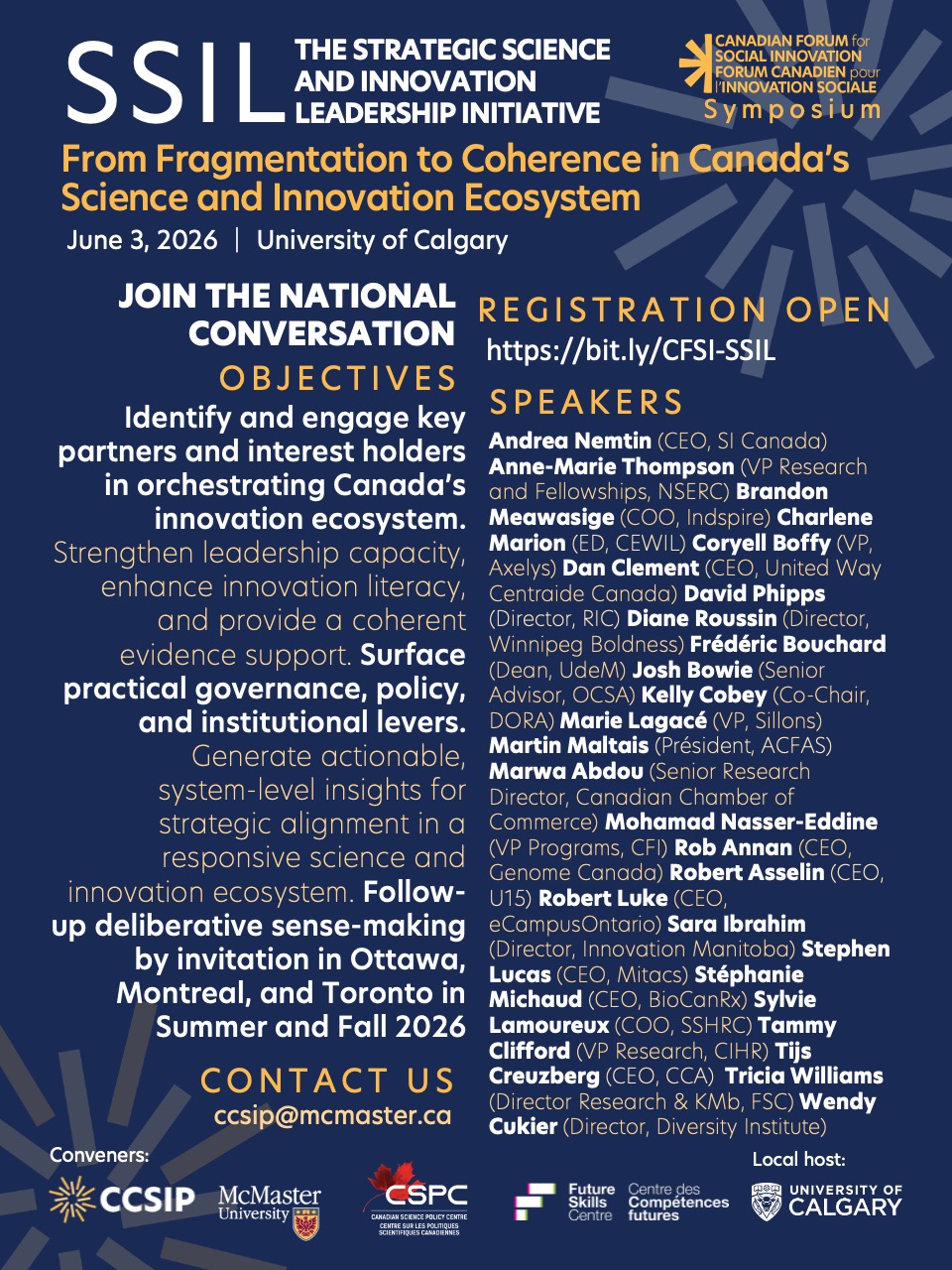
L’Initiative de leadership stratégique en sciences et innovation (SSIL)
L’Initiative de leadership stratégique en sciences et innovation (SSIL) sera lancée le 3 juin à Calgary dans le cadre d’un effort collectif visant à franchir ces premières étapes indispensables. ...Tout Lire

Principes de co-création axée sur l’équité (EqCC)
La co-création axée sur l’équité (EqCC) est une approche collaborative développée à l’Université McMaster (Mulvale et al., 2024 ; Mulvale et al., 2025) qui favorise des systèmes de connaissances équitables en redistribuant intentionnellement le pouvoir tout au long du processus de recherche. ...Tout Lire

Future-Ready Graduate Education in Canada
Les 15 et 16 octobre 2025, la Fédération des sciences humaines, l’Association canadienne des études supérieures et le Collaboratif canadien de collaboration pour la société, l’innovation et les politiques (CCSIP) ont accueilli une centaine de participants à l’Université McMaster pour deux jours de discussions et d’échanges délibératifs lors du Sommet Voir Grand sur la formation […] ...Tout Lire
Social Innovation Now.
Malgré les idées reçues, la recherche en SHS produit des connaissances clefs sur les dimensions humaines et sociales d'un large éventail de défis et de questions urgentes qui peuvent être bénéfiques à nos institutions et à nos communautés. ...Tout Lire

Building Capacity for Innovation in the Social Sector
Charities and nonprofits are trying to address some of society’s most challenging problems: poverty, homelessness, addiction, mental health, and environmental degradation, to name just a few. Tackling these problems requires both innovation and systems-level change. This report discusses the social sector’s interest in innovation and the factors affecting its innovation capacity. The authors argue that […] ...Tout Lire

Community Innovation and Impact in University-Based Social Sciences, Humanities and Arts
Just like any other aspect of academic activity, to be successful, community innovation and impact thrives best on a strategic vision that it is supported by apt organizational policies and infrastructure, as well as being adequately resourced, incentivised and rewarded. There is cause 10 for concern when an academic pursuit is said to be valued […] ...Tout Lire

Skills for Inclusive and Collaborative Innovation
Skills do not evolve in a vacuum. What this means is that while individuals on all side of the science-society interface do need to build skills and acquire competencies to bolster knowledge use, skills also evolve in organizations and organizations need to be structured in such a manner as to enable them. A strong science […] ...Tout Lire

Drivers and Barriers to SSHA Contributions at the Interface with Policy
Despite their relevance, SSHA engagement at the SPI is constrained by two persistent barriers: low connectivity (across disciplines and sectors) and low institutional capacity (within both academia and policy systems). Structural misalignments, disciplinary silos, and underdeveloped collaborative infrastructures limit SSHA influence. However, where SSHA integration succeeds, it is driven by trusted relationships, reflexive institutional cultures, […] ...Tout Lire